Surveillance Data Quality Management (SDQM)
Disease surveillance is only as good as its data. Surveillance Data Quality Management (SDQM) gave NCDC and State Ministries of Health a routine, shared way to measure the quality of the data in SORMAS and fix what holds it back.
SDQM was set up to improve how disease cases are reported, the quality of the data, and how that data is used, at the Nigeria Centre for Disease Control and Prevention (NCDC) and in State Ministries of Health. It treats data quality as a performance to be managed, led by teams that bring together different skills and have agreed roles.
The approach was developed jointly by NCDC, State Ministries of Health, the United States Centers for Disease Control and Prevention (US CDC) and the World Health Organization (WHO). Each cycle includes an assessment of performance, a monthly data review meeting, tracking of key quality indicators, and analysis of the root causes of any gaps so they can be fixed.
The challenge
What we did
Assessed performance
Compared cases in SORMAS with state line lists (spreadsheets of individual cases) and health facility registers to set a baseline and a method for checking data.
Defined what to measure
Agreed and piloted four measures: whether every case on the state line list is also in SORMAS; whether key details are filled in; whether reports arrive on time; and whether every local government area reports.
Set up improvement teams
Created teams at NCDC and in states, with agreed roles and a standing monthly meeting.
Acted on the gaps
Supported a SORMAS user toolkit, simpler case investigation forms agreed with disease working groups, supportive supervision at local government and facility level, internet data for local surveillance officers, and entry of backlogged data.
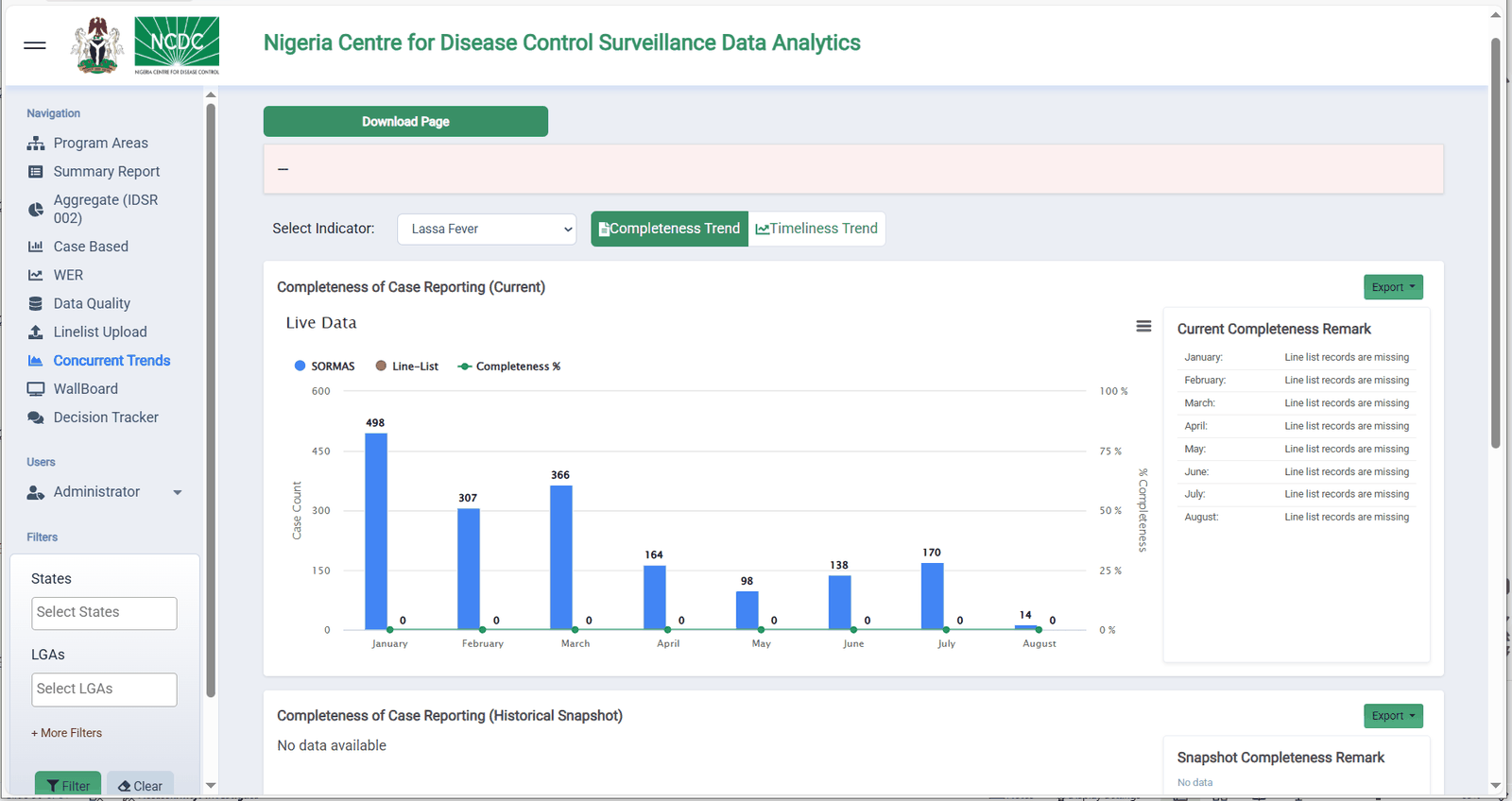
The tool used for monthly reviews
SDQM reviews use DAVT, NCDC’s data analysis platform, to compare SORMAS with state line lists.
Results
Built into NCDC and state routines
A written procedure now guides how to review data, find quality gaps and drive improvement.
More reporting in SORMAS
During the pilot, reporting in SORMAS increased in all four states between August and September 2024.
Evidence that shaped the system upgrade
SDQM findings on forms, synchronisation problems and reporting routes directly shaped the SORMAS optimisation and the data quality tools in DAVT.
Lessons learned
- SDQM created ownership of, and accountability for, complete and accurate data.
- Improving data quality needs a joined-up strategy, carried out in detail at every level.
- National and state investment, resources and political commitment are needed to fix the many issues that affect data in SORMAS.
- Reducing the number of reporting channels, and reporting COVID-19 and Mpox through routine surveillance, would improve the data available.